Indication

Neulasta® (pegfilgrastim) is indicated to decrease the incidence of infection, as manifested by febrile neutropenia, in patients with nonmyeloid malignancies receiving myelosuppressive anti-cancer drugs associated with a clinically significant incidence of... Read More

Neulasta® (pegfilgrastim) is indicated to decrease the incidence of infection, as manifested by febrile neutropenia, in patients with nonmyeloid malignancies receiving myelosuppressive anti-cancer drugs associated with a clinically significant incidence of febrile neutropenia... Read More

You are going to a website that contains clinical information and was created specifically for patients. If you are not a patient and would like to return to the healthcare professional site, please click CANCEL.

Neulasta® Onpro® helps your patients stay on track with their treatment plan

For appropriate patients receiving myelosuppressive chemotherapy

Febrile neutropenia (FN) has the potential to disrupt your patient’s treatment strategy1

94 Percent

Next-day Neulasta® REDUCED
THE INCIDENCE OF FN BY 94%
when used every cycle2,†

*Neulasta® 1% vs placebo 17%, P < 0.001.

Phase 3, multicenter, multinational, double-blind, placebo-controlled trial of patients with breast cancer (Neulasta® [n = 463] or placebo [n = 465]) receiving 100 mg/m2 docetaxel Q3W for up to 4 cycles. Patients were randomized to receive a single subcutaneous injection of Neulasta® (6 mg) or placebo on day 2 of each chemotherapy cycle. The key endpoint was the percentage of patients who developed FN (Neulasta® 1% vs placebo 17%, P < 0.001). Also, secondary endpoints were lower for Neulasta®-treated patients as compared to placebo-treated patients (the incidence of hospitalization [1% vs 14%] and IV anti-infective use [2% vs 10%]).2

FN = febrile neutropenia; Q3W = once every 3 weeks; IV = intravenous.

Dose delays and dose reductions are unwanted disruptions to your patient’s treatment plan. Clinical studies measure this occurrence with a metric known as relative dose intensity (RDI).
The accepted benchmark of RDI > 85% is considered RDI maintained.1

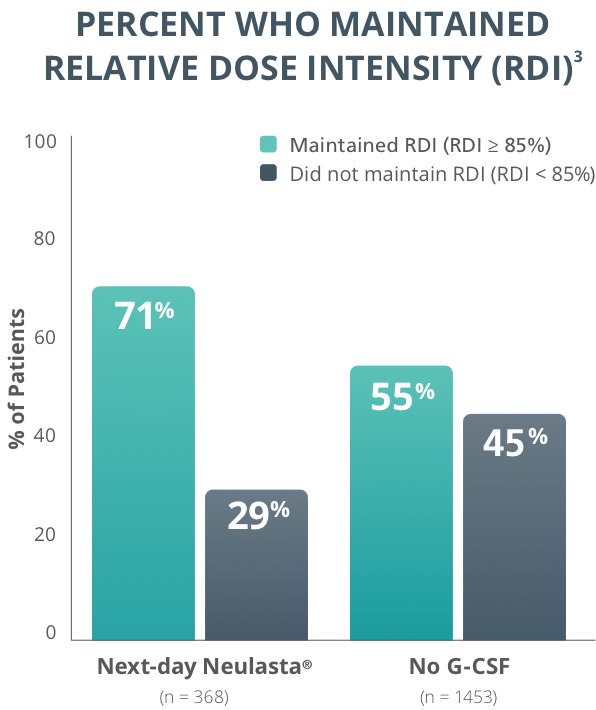
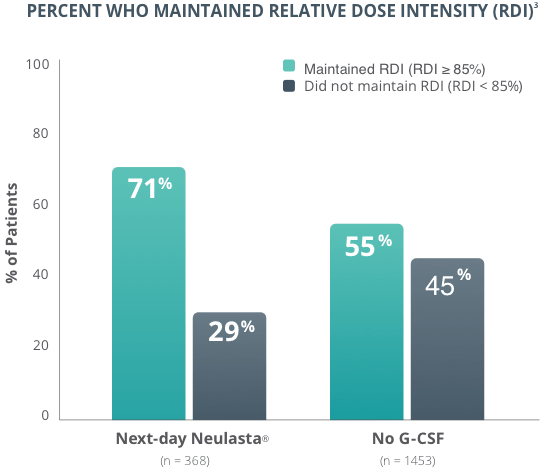
Next-day Neulasta® reduced risk of FN and helped significantly more patients maintain relative dose intensity (RDI)

98 Perecent

Unadjusted for clinical and demographic characteristics, 98% more likely to maintain RDI over the course of chemotherapy vs no G-CSF3,*,†

Next-day Neulasta®: 0.709 / 0.291 = 2.33

No G-CSF: 0.552 / 0.448 = 1.23

BracketBracket

2.33 / 1.23 = 1.98

Note: The odds ratio is the relationship of the next-day Neulasta® group’s odds to the No G-CSF group’s odds of maintaining RDI.

48 Percent

Adjusted for clinical and demographic characteristics, 48% more likely to maintain RDI over the course of chemotherapy vs no G-CSF3,*,†

More than 9 out of 10 HCPs agreed that Onpro helped maintain their patients’ treatment plan during COVID-19

More than 9 out of 10 HCPs agreed that Onpro® helped maintain their patients’ treatment plan during COVID-194

*RDI ≥ 85%.

Course-level analysis. All cycles included. The analysis categorized patients as next-day Neulasta® users vs non-users of G-CSF based on the first cycle of chemotherapy only. However, for patients who received next-day Neulasta® in cycle 1, subsequent Neulasta® use was: 87% in cycle 2, 86% in cycle 3, and 78% in cycle 4. For patients who did not receive any G-CSF in cycle 1, no G-CSF use was 81% in cycle 2, 79% in cycle 3, and 79% in cycle 4.

Adjusted odds ratio controlling for clinical and demographic characteristics, including but not limited to age, metastasis (yes/no), and FN risk of chemotherapy regimen.

FN = febrile neutropenia; RDI = relative dose intensity; G-CSF = granulocyte colony-stimulating factor.

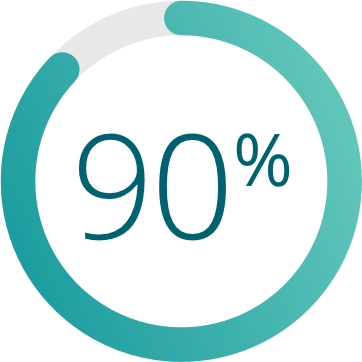
90% of HCPs say they would use Onpro over a G-CSF prefilled syringe post-COVID-19

90% of HCPs say they would use Onpro® over a G-CSF prefilled syringe post-COVID-194

Relative dose intensity next-day Neulasta vs. no G-CSFRelative dose intensity next-day Neulasta vs. no G-CSF

Study Design: Retrospective cohort study conducted at Geisinger Health System (Danville, PA), Henry Ford Health System (Detroit, MI), Kaiser Permanente Northwest (Portland, OR), and Reliant Medical Group (Worcester, MA), January 2009-December 2017 (for all sites except Geisinger, 2009-2014). Analysis included patients with breast cancer, colorectal cancer, lung cancer, or non-Hodgkin’s lymphoma, receiving chemotherapy regimens with high or intermediate risk of FN. Multivariable regression models were employed to estimate the relationship between the use of Neulasta® and RDI.

Dose intensity is defined as the delivered dose of chemotherapy per unit of time. Relative dose intensity (RDI) is expressed as a percentage, calculated as the delivered dose intensity divided by the standard dose intensity. A higher RDI is indicative of fewer dose reductions and delays. Patients with RDI ≥ 85% were considered to have maintained their dose. The 85% cut point is commonly reported in the literature.1

It was not possible to determine from the data whether patients received Onpro® or the prefilled syringe. However, of the 379 patients from these healthcare systems who received Neulasta® in the first cycle, 97% (n = 368) received it on the day following chemotherapy, as recommended in the Neulasta® Prescribing Information. The Neulasta® group in this analysis was limited to next-day patients.

RDI = relative dose intensity; G-CSF = granulocyte colony-stimulating factor.

In a Real-World Study with nearly 11,000 patients

Delivering pegfilgrastim via prefilled syringe resulted in a significantly higher risk of FN vs Onpro®5,†

31 Percent

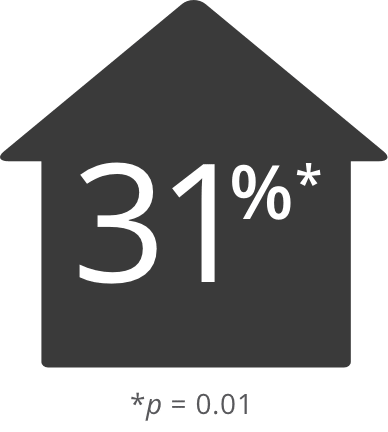
Patients receiving Neulasta® via prefilled syringe experienced a 31% increased incidence of FN vs Neulasta® Onpro®5,†

  • Across all cycles of chemotherapy, the incidence of FN associated with prefilled syringe was 1.7% (n = 455) vs 1.3% (n = 126) for Neulasta® Onpro®5

FN was defined as:5

  • Inpatient: Diagnosis of neutropenia AND (fever OR inpatient diagnosis of infection)
  • Outpatient: Diagnosis of neutropenia AND (fever OR diagnosis of infection AND prescribed antimicrobials)

FN = temperature ≥ 38.2°C and absolute neutrophil count < 0.5 x 10⁹/L.

FN = febrile neutropenia.

Real-World Study Design5

A retrospective study designed to compare the incidence of FN associated with Neulasta® Onpro® vs Neulasta® PFS among patients receiving myelosuppressive chemotherapy. The study included 35,856 cycles of chemotherapy in which Neulasta® was administered (9395 Neulasta® Onpro® and 26,461 PFS administrations).

  • Patients were followed for 6 to 12 months following the start of the first chemotherapy cycle. The study period was 1/1/16-9/30/18
  • Data Source: MarketScan® Commercial Claims and Encounters/Medicare Supplemental and Coordination of Benefits Databases
Real-World Study Limitations5
  • Retrospective analysis that did not control for additional variables that may influence the incidence of FN
  • Database was not sufficient to understand root causes for observed lower rate of FN for patients receiving Onpro®

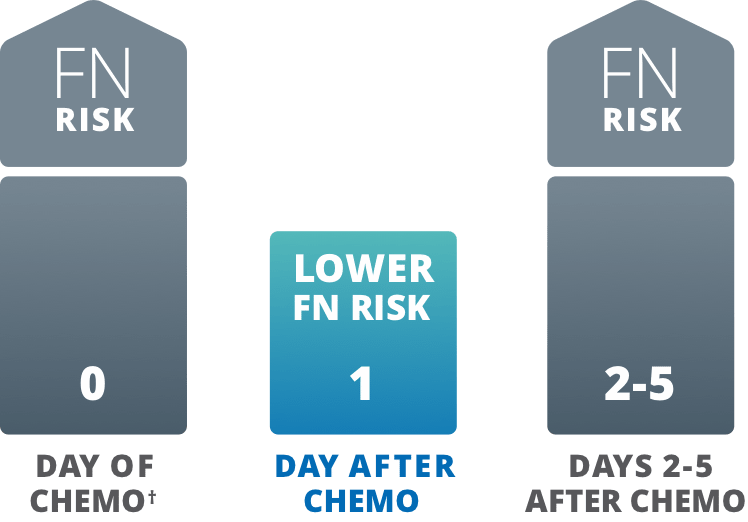
Febrile neutropenia (FN) risk increases when pegfilgrastim is not administered the day after chemotherapy2,6

NCCN Clinical Practice Guidelines in Oncology (NCCN Guidelines®) state that pegfilgrastim should be administered the day after chemotherapy (category 1 recommendation)6

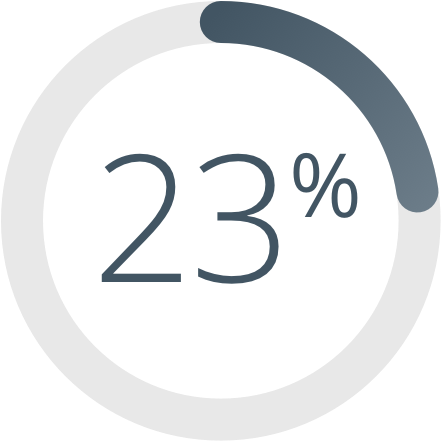
23% of Neulasta cycles were administered on days other than the day after chemotherapy

of Neulasta® cycles were administered on DAYS OTHER THAN THE DAY AFTER chemotherapy7

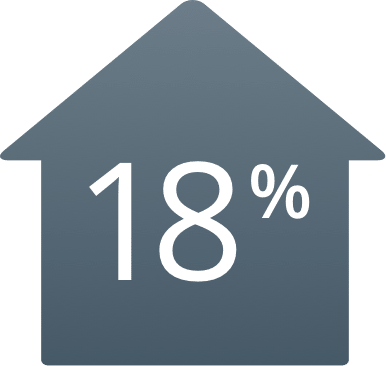
18% increased risk of FN when Neulasta was administered on days other than the day after chemotherapy

INCREASED RISK OF FN when Neulasta® was administered on days other than the day after chemotherapy7,*

FN rate for the day after chemotherapy vs all other days of Neulasta® administration was 2.53% and 3.04%, respectively.7

chart image

Neulasta® Onpro® is designed to deliver 27 hours after application in accordance with labeling.8

Do not administer Neulasta® between 14 days before and 24 hours after administration of chemotherapy.8

Retrospective analysis based on IMS PharMetrics Plus™ and Truven Health Analytics MarketScan® Commercial and Medicare Supplemental claims data, covering over 30 million persons annually. The data included all patients ≥ 18 years who, between July 1, 2010, and September 30, 2015, initiated ≥ 1 course of myelosuppressive chemotherapy for a primary solid tumor or NHL. Patients who received a chemotherapy regimen with a risk of FN and pegfilgrastim prophylaxis in ≥ 1 cycles were selected for inclusion in the study. FN inpatient care was identified based on an inpatient admission with a diagnosis (principal or secondary) of neutropenia, fever, or infection using ICD-9 and ICD-10 codes. FN outpatient care was based on an outpatient encounter with a diagnosis of neutropenia, fever or infection, and—on the same date—code for IV administration of antimicrobial therapy.7

*18% is the increase in relative risk comparing days other than the day after chemotherapy to the day after chemotherapy. Relative risk was estimated using GEE to account for correlation among repeated measures for the same subject, and adjusted using backward selection of patient, cancer, and treatment characteristics.7

†Do not administer Neulasta® the same day as chemotherapy.8

FN = febrile neutropenia; NCCN® = National Comprehensive Cancer Network; NHL = non-Hodgkin’s lymphoma; GEE = generalized estimating equations; ICD-9 = International Classification of Diseases, 9th Revision; ICD-10 = International Classification of Diseases, 10th Revision


Adherence to G-CSF therapy was higher with Neulasta® Onpro® than with prefilled syringe9

Neulasta onpro vs injectionNeulasta onpro vs injection
  • Adherence is defined as proportion of patients receiving treatment according to Clinical Practice Guidelines10
  • In this analysis, adherence was based on a comparative analysis of Neulasta® doses administered by prefilled syringe vs Neulasta® Onpro® that was conducted using data from OSCER on 389,000 oncology patients who were seen in 2016. Percentage of dose administered was calculated by taking the sum of patients’ chemotherapy cycles with Neulasta® and dividing by the sum of their total chemotherapy cycles. Both arms were assumed to have received the treatment as prescribed9

G-CSF = granulocyte colony-stimulating factor; OSCER = Oncology Services Comprehensive Electronic Records.

Incomplete doses have been reported with Neulasta® Onpro® due to device not performing as intended. This may increase risk of neutropenia, febrile neutropenia, and/or infection.

Important Safety Information

Contraindication
  • Neulasta® (pegfilgrastim) is contraindicated in patients with a history of serious allergic reactions to pegfilgrastim or filgrastim
  • Reactions have included anaphylaxis
Splenic Rupture
  • Splenic rupture, including fatal cases, can occur following the administration of Neulasta®
  • Evaluate for an enlarged or ruptured spleen in patients who report left upper abdominal or shoulder pain
Acute Respiratory Distress Syndrome (ARDS)
  • ARDS has occurred in patients receiving Neulasta®
  • Evaluate patients who develop a fever and lung infiltrates or respiratory distress after receiving Neulasta®
  • Discontinue Neulasta® in patients with ARDS
Serious Allergic Reactions
  • Serious allergic reactions, including anaphylaxis can occur in patients receiving Neulasta®
  • Majority of events occurred upon initial exposure and can recur within days after discontinuation of initial anti‐allergic treatment
  • Permanently discontinue Neulasta® in patients with serious allergic reactions
Allergies to Acrylics
  • On‐body injector (OBI) for Neulasta® uses acrylic adhesives
  • Patients who are allergic to acrylic adhesives may have a significant reaction
Use in Patients With Sickle Cell Disorders
  • In patients with sickle cell trait or disease, severe and sometimes fatal sickle cell crises can occur in patients receiving Neulasta®
  • Discontinue Neulasta® if sickle cell crisis occurs
Glomerulonephritis
  • Has occurred in patients receiving Neulasta®
  • Diagnoses based on azotemia, hematuria, proteinuria, and renal biopsy
  • Generally events resolved after dose reduction or discontinuation of Neulasta®
  • If suspected, evaluate for cause and if cause is likely, consider dose‐reduction or interruption of Neulasta®
Leukocytosis
  • Increased white blood cell counts of 100 x 109/L have been observed
  • Monitoring CBCs during Neulasta® therapy is recommended
Capillary Leak Syndrome (CLS)
  • CLS has been reported after G‐CSF administration, including Neulasta®
  • Characterized by hypotension, hypoalbuminemia, edema, and hemoconcentration
  • Episodes vary in frequency, severity, and may be life‐threatening if treatment is delayed
  • Patients with symptoms should be closely monitored and receive standard symptomatic treatment, which may include intensive care
Potential for Tumor Growth Stimulatory Effects on Malignant Cells
  • G‐CSF receptor has been found on tumor cell lines
  • The possibility that pegfilgrastim acts as a growth factor for any tumor type, including myeloid malignancies and myelodysplasia, diseases for which Neulasta® is not approved, cannot be excluded
Potential Device Failures
  • Missed or partial doses have been reported in patients receiving pegfilgrastim via the on‐body injector (OBI) due to the device not performing as intended
  • In the event of a missed or partial dose, patients may be at increased risk of events such as neutropenia, febrile neutropenia and/or infection than if the dose had been correctly delivered
  • Instruct patients to notify their healthcare professional immediately in order to determine the need for a replacement dose if they suspect that the device may not have performed as intended
Aortitis
  • Aortitis has been reported in patients receiving Neulasta®. It may occur as early as the first week after start of therapy
  • Manifestations may include generalized signs and symptoms such as fever, abdominal pain, malaise, back pain, and increased inflammatory markers (e.g., c-reactive protein and white blood cell count)
  • Consider aortitis in patients who develop these signs and symptoms without known etiology. Discontinue Neulasta® if aortitis is suspected
Nuclear Imaging
  • Increased hematopoietic activity of the bone marrow in response to growth factor therapy has been associated with transient positive bone imaging changes. This should be considered when interpreting bone imaging results
Most common adverse reactions
  • Bone pain
  • Pain in extremity

Please see Neulasta® full Prescribing Information.

Neulasta® Injection: 6 mg/0.6 mL in a single-dose prefilled syringe for manual use only.

Neulasta® Injection: 6 mg/0.6 mL in a single-dose prefilled syringe co-packaged with the on-body injector (OBI) for Neulasta® (Neulasta® Onpro® kit).

Special Instructions for the On‐body Injector (OBI) for Neulasta®

A healthcare provider must fill the on‐body injector (OBI) with Neulasta® using the co‐packaged prefilled syringe and then apply the OBI to the patient’s skin (abdomen or back of arm). The back of the arm may only be used if there is a caregiver available to monitor the status of the OBI. Approximately 27 hours after the OBI is applied to the patient’s skin, Neulasta® will be delivered over approximately 45 minutes. A healthcare provider may initiate administration with the OBI on the same day as the administration of cytotoxic chemotherapy, as long as the OBI delivers Neulasta® no less than 24 hours after the administration of cytotoxic chemotherapy.

The prefilled syringe co‐packaged in the Neulasta® Onpro® kit contains additional solution to compensate for liquid loss during delivery through the OBI. If this syringe is used for manual subcutaneous injection, the patient will receive an overdose. If the prefilled syringe for manual use is used with the OBI, the patient may receive less than the recommended dose.

Do not use the OBI to deliver any other drug product except the Neulasta® prefilled syringe co‐packaged with the OBI. Use of the OBI has not been studied in pediatric patients.

The OBI should be applied to intact, non‐irritated skin on the arm or abdomen.

A missed dose could occur due to an OBI failure or leakage. Instruct patients using the OBI to notify their healthcare professional immediately in order to determine the need for a replacement dose of pegfilgrastim if they suspect that the device may not have performed as intended. If the patient misses a dose, a new dose should be administered by single prefilled syringe for manual use as soon as possible after detection.

Review the Patient Information and Patient Instructions for Use with the patient and provide the instructions to the patient.

Refer to the Healthcare Provider Instructions for Use for the OBI for full administration information.

For any OBI problems, call Amgen at 1‐800‐772‐6436 or 1‐844‐MYNEULASTA (1‐844‐696‐3852).

References:

1. Lyman GH. J Natl Compr Canc Netw. 2009;7:2612-2615. 2. Vogel CL, et al. J Clin Oncol. 2005;23:1178-1184. 3. Data on file, Amgen; [1]; 2020. 4. Data on file, Amgen; [2]; 2020. 5. Data on file, Amgen; [3]; 2020. 6. Referenced with permission from the NCCN Clinical Practice Guidelines in Oncology (NCCN Guidelines®) for Myeloid Growth Factors V.2.2020. ©National Comprehensive Cancer Network, Inc. 2020. All rights reserved. Accessed October 23, 2020. To view the most recent and complete version of the guideline, go online to NCCN.org. NCCN makes no warranties of any kind whatsoever regarding their content, use or application and disclaims any responsibility for their application or use in any way. 7. Data on file, Amgen; 2018. 8. Neulasta® (pegfilgrastim) Prescribing Information, Amgen. 9. Data on file, Amgen; 2017. 10. Ament SMC, et al. BMJ Open. 2015;5:e008073. doi:10.1136/bmjopen-2015-008073.